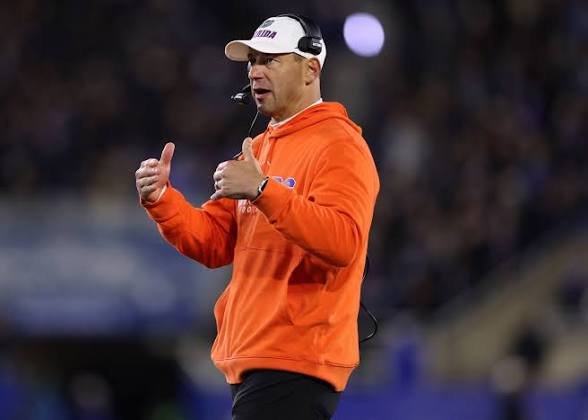

Florida head coach Jon Sumrall has identified what his roster needs. The bigger question involves whether the Gators can afford it.
Sumrall wants 10 to 12 impact transfers this offseason. He isn’t interested in collecting bodies simply to increase roster numbers. He wants difference-makers.
However, one comment from Monday’s press conference deserves particular attention.
“I want to go add 10 to 12 dudes. Like, difference makers. That’s my desire. Now, sometimes do we have the resourcing to do that? We’ll find out.”
That final statement changes the conversation.
Florida isn’t simply evaluating its transfer portal targets. The program must determine whether its financial commitments match its competitive ambitions.
For a team attempting to establish itself among the SEC’s strongest programs, this offseason could become a defining moment.
The Tape & Scheme Analysis: Florida Needs Protection Before More Firepower
Florida’s transfer priorities should begin in the trenches.
Quarterback remains an important position. However, upgrading the offensive tackle positions could produce a more immediate improvement across the entire offense.
The Gators need two starting-caliber tackles who can survive SEC pass-rush matchups.
Consider the schematic implications.
Modern SEC defenses frequently create pressure through simulated blitzes, overloaded fronts, and disguised coverage rotations. Offensive tackles must recognize these threats before the quarterback reaches his throwing motion.
An unstable tackle position forces offensive coordinators into predictable protection adjustments.
That creates problems.
Florida could become dependent on keeping tight ends attached to the formation. Running backs might also spend additional snaps protecting the quarterback instead of releasing into routes.
Those adjustments reduce the number of available receiving threats.
Elite tackles would give Florida greater flexibility.
The offensive coordinator could distribute five-man protections more confidently. Play-action concepts would become more effective. Outside-zone runs would also have better opportunities to develop.
That matters for establishing offensive balance.
Florida’s quarterback evaluation must also account for protection quality. A quarterback operating behind inconsistent tackles faces unnecessary pressure.
Pocket presence cannot consistently overcome defensive penetration.
The defensive secondary presents another major concern.
Florida needs an established outside cornerback and an experienced STAR defender.
The outside corner must handle isolated coverage responsibilities. That would allow defensive coordinator Brad White to consider more aggressive coverage combinations.
A reliable corner could make Cover 3 and quarters concepts more effective.
Meanwhile, the STAR position requires a different skill set.
Florida needs someone capable of covering slot receivers, supporting the run defense, and handling pressure assignments.
That versatility creates additional defensive possibilities.
The STAR defender can rotate toward the box without automatically exposing the entire secondary.
The tactical argument is straightforward: Florida needs better protection and stronger coverage before chasing additional offensive weapons.
A quarterback upgrade would still matter. But protecting that quarterback must become part of the same evaluation.
Recruiting & Roster Depth Context: Four Transfers Could Change Everything
Florida’s transfer strategy represents a departure from simply prioritizing recruiting volume.
Sumrall wants 10 to 12 difference-makers. That approach demands considerably more evaluation and financial discipline.
The previous offseason demonstrated the limitations of quantity.
Florida brought in numerous transfers while Sumrall was managing responsibilities associated with his previous position at Tulane.
The resulting class generated questions about its overall impact.
This time, the objective appears more specific.
The Gators should identify four premium positions before addressing secondary needs.
Those positions are quarterback, offensive tackle, cornerback, and STAR.
Recruiting rankings alone cannot determine whether a transfer deserves a major financial commitment.
A highly rated recruit might possess excellent physical tools but lack starting experience. Conversely, an experienced Group of Five transfer could offer immediate SEC-level production.
Florida must evaluate both.
The program also needs to protect its existing recruiting investments.
Developing four-star and five-star prospects remains essential. Spending heavily on transfers cannot become an excuse to neglect high-school recruiting.
The ideal roster combines experienced transfers with developing young talent.
That creates competition without blocking the development of promising freshmen.
Florida should also avoid unnecessary duplication.
If the Gators already possess young depth at a particular position, spending premium resources there makes little sense.
The priority should be identifying positions where the current roster lacks proven SEC-caliber starters.
Projected roster priorities:
- Quarterback: Find a reliable starter with strong pocket awareness.
- Offensive tackle: Add two immediate starting candidates.
- Cornerback: Secure an experienced outside coverage defender.
- STAR: Find a versatile defender capable of handling multiple assignments.
Four excellent additions could provide more value than 12 average transfers.
The Projected Depth Chart Impact
The following is a projected positional strategy, not a confirmed starting lineup. Final assignments will depend on returning players and portal additions.
| Position | Current Roster Approach | Desired Portal Addition | Projected Impact |
|---|---|---|---|
| Quarterback | Evaluate returning competition | Proven starting-caliber QB | Stabilizes offensive execution |
| Left Tackle | Develop existing options | Elite transfer tackle | Improves blindside protection |
| Right Tackle | Evaluate positional depth | Experienced transfer tackle | Strengthens both edges |
| Outside CB | Develop returning corners | Experienced coverage specialist | Improves perimeter coverage |
| STAR/Nickel | Evaluate versatile defenders | Starting-caliber nickel | Expands defensive flexibility |
| Interior OL | Retain and develop depth | Additional option if necessary | Improves rotational stability |
| Edge Rusher | Develop existing pass rushers | Selective upgrade | Improves third-down pressure |
The most important detail is positional balance.
Florida shouldn’t spend heavily on one side of the football while ignoring another.
Two tackles, one cornerback, and one STAR defender would represent a strong foundation. The remaining resources could address quarterback and other roster weaknesses.
The Financial Question: Florida Must Match Its Ambitions
Florida’s financial position deserves serious scrutiny.
The program has often presented itself as a major NIL competitor. However, outside estimates have placed its spending below several national heavyweights.
Some estimates have ranked Florida approximately 11th through 20th nationally.
Those figures aren’t audited financial disclosures. They should therefore be treated cautiously.
Still, the competitive implications are important.
The difference between a recruiting operation ranked around 12th and one consistently competing inside the top five can become significant.
Florida’s historical investment decisions also create an uncomfortable comparison.
In 2024, retaining Billy Napier was partly justified by the possibility of redirecting potential buyout resources toward roster construction.
The subsequent 2025 transfer class produced eight additions without attracting major financial headliners.
That history makes Sumrall’s latest comments particularly interesting.
Florida doesn’t necessarily need to outspend Texas, LSU, or Georgia.
It needs to spend intelligently.
The objective should be identifying players whose production justifies their financial demands.
Paying premium money for average production would simply recreate the same problem.
The SEC Outlook: Florida’s 2027 Ceiling Depends on Four Decisions
Florida has demonstrated that it can compete with expensive SEC rosters.
Its victory over Texas illustrated that financial rankings don’t automatically determine Saturday’s results.
However, isolated victories aren’t enough.
Georgia, Alabama, Texas, LSU, and Tennessee continue to demand excellent roster construction.
Florida cannot afford significant weaknesses at premium positions.
My projection is straightforward.
If Sumrall secures two starting-caliber offensive tackles, a legitimate cornerback, and an impact STAR defender, Florida could become considerably more competitive in 2027.
Add a dependable quarterback, and an eight-win regular season becomes a realistic target.
Without those upgrades, another season of inconsistent performances remains possible.
The biggest threat to Florida isn’t necessarily a lack of talent. It’s failing to convert its resources into the right talent.
Sumrall has identified the positions requiring attention.
Now the administration must demonstrate whether it shares his ambitions.
His final statement remains the most important part of this entire discussion:
“We’ll find out.”
Florida fans are about to discover exactly how serious the program is about building a championship-caliber roster.