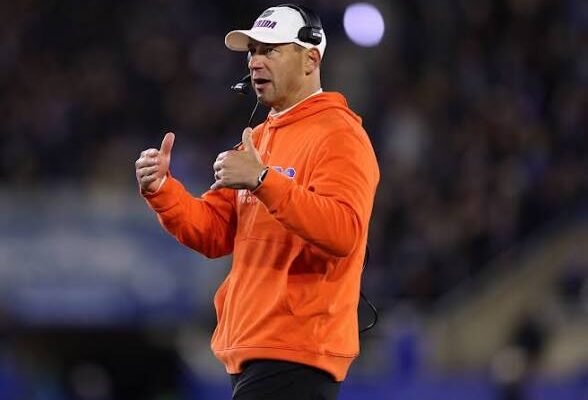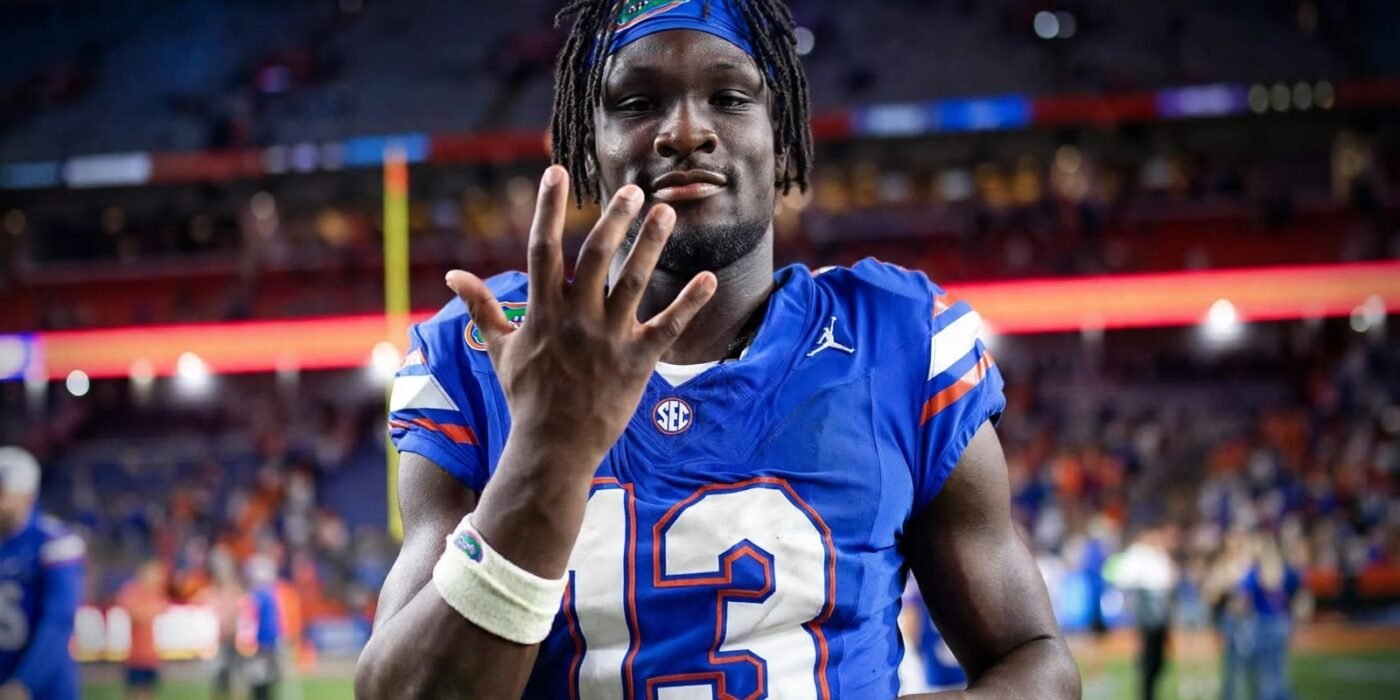

Florida has not had much go according to plan in 2026. The record has wobbled. The offense has stalled for stretches. The noise around the program has rarely quieted.
Jadan Baugh has been the exception.
Through 10 games, the third-year running back has turned into the one player Florida can lean on when a drive has to stay alive, when the red zone gets tight, and when the game starts tilting the wrong way. Now that production is showing up where it matters for his future: in first-round mock draft conversation.
In Sports Illustrated’s recent 2027 NFL mock draft, Baugh is projected to go No. 22 overall to the New York Giants. It is not just a nice mention in a long list. Sports Illustrated identifies him as a potential three-down back and a leading candidate to be the first running back taken in the 2027 draft.
That is the kind of projection that changes how a season is remembered.
Why the Giants fit makes sense
The Giants did not stumble into this need by accident.
Before the NFL trade deadline, New York explored running back options and discussed potential deals involving Tony Pollard and Bijan Robinson. None of it landed. The Giants ultimately failed to secure a back, which left the position as a potential priority heading into the offseason.
That context matters because mock drafts are not just about talent rankings. They are about team needs meeting available players at the right pick. At No. 22, Baugh would give New York what it has been searching for: another downhill runner who can carry an offense without needing a perfect situation around him.
The “three-down” label is the key part. In today’s NFL, teams do not spend first-round picks on backs who come off the field on third down. They spend them on backs who can run between the tackles, pass-protect, catch the ball out of the backfield, and stay on the field when the playbook opens up. That is the evaluation Sports Illustrated is putting on Baugh.
For Florida fans, it is also a useful reminder of how far his game has come. He is no longer just a big back who gets what is blocked. He is being talked about as a complete back.
The numbers behind the rise
Baugh’s case is not built on one hot Saturday. It is built on steady, heavy production.
Through 10 games this season, he has rushed for 905 yards and 15 touchdowns on 178 carries, averaging 5.1 yards per carry. He has added 11 receptions for 73 yards, bringing his total to 978 yards from scrimmage.
That touchdown total does a lot of the talking. Fifteen rushing scores in 10 games means Florida has trusted him in the situations where yards get hardest to find. Short yardage. Goal line. Late in games when defenses know the run is coming. Baugh has still found a way to finish.
The start of the season set the tone:
Florida Atlantic: 160 rushing yards, 3 touchdowns
Campbell: 136 rushing yards, 2 touchdowns
Auburn: 162 rushing yards, 3 touchdowns
Ole Miss: 142 rushing yards, 3 touchdowns
Four games. Six hundred rushing yards. Eleven touchdowns. That is not a back getting hot against soft fronts. Auburn and Ole Miss are SEC defenses that game-plan to stop the run first. Baugh still produced explosive, scoring performances against both.
Then came the grind part of the season, the part that separates draft hype from draft staying power.
What Kentucky showed about his value
Baugh’s most recent highlighted performance was not a 150-yard explosion. It was Florida’s 21-14 win over Kentucky, when he finished with 69 rushing yards and a touchdown on 18 carries.
On paper, that looks modest next to his September numbers. In context, it might be just as important.
Florida needed to close out a tight, physical SEC game. Baugh got 18 carries. He kept the chains moving. He scored. He took the kind of workload that wears defenses down even when the highlight runs are not there.
That is what NFL evaluators watch in November: does the back still run with the same pad level, patience, and finish when his legs are tired and the defense has a full season of tape on him?
Baugh’s season suggests the answer is yes. His production was not where it needed to be midseason, according to the source report, yet his emergence as a potential first-round selection underscores his talent even through that stretch. In other words, the dip did not erase the evaluation. If anything, his ability to keep scoring and keep carrying the load through it strengthened it.
What this means inside Florida’s offense
For the Gators, Baugh has become the stabilizer.
When Florida’s offense has been at its best this season, it has usually started with Baugh getting downhill early. Those early-down runs do two things: they keep Florida ahead of the chains on second and third down, and they force safeties and linebackers to respect play-action. Without that threat, the passing game gets squeezed.
His 5.1 yards per carry matters for that reason. It is not just an efficiency number. It means Florida is not living in third-and-long. It means the offensive line is getting movement, Baugh is making the first defender miss or running through contact, and the offense is staying on schedule.
The receiving numbers, 11 catches for 73 yards, are not huge. But they matter for the three-down projection. Even a modest receiving role shows Florida is comfortable using him as more than a first- and second-down runner. If the coaching staff chooses to expand that part of his game late in the season, that would only help his draft case. It would also give Florida another way to get him the ball when stacked boxes take away inside runs.
The bigger question for Florida now is not whether Baugh can produce. It is how much more the Gators can get out of him without running him into the ground before the postseason picture settles.
Why first-round running back talk still matters
Running backs do not get first-round love the way they used to. Teams are cautious with the position. They worry about tread on the tires, short shelf life, and whether they can find similar production later in the draft.
That is why a projection like this carries weight.
To be discussed as the first running back off the board, Baugh has to clear a higher bar than just being productive in college. He has to look like a back who can handle 250-plus touches, protect the quarterback, and create yards that are not blocked for him.
His combination of explosiveness and physicality is what has positioned him as a potential first-round selection, according to the report. That phrase, explosiveness plus physicality, is exactly what NFL teams want from a lead back. Explosiveness gets you chunk plays. Physicality gets you the tough yards that win fourth quarters.
Florida has described Baugh all season as one of its dynamic offensive weapons, and that description has held up through the ups and downs of the 2026 season. The mock draft is just the national version of what Gators fans have been seeing every week.
What could still change
Plenty could change between now and the 2027 NFL draft. That is not a hedge. That is how this process works.
Mock drafts in November are snapshots, not promises. Team needs will shift with free agency. Other running backs will rise during bowl season, the combine, and pro days. Baugh’s final games, his health, and how he tests will all factor into where he ultimately lands.
What is harder to change is the foundation he has built: 905 rushing yards, 15 touchdowns, and a run of SEC performances that show he can handle a featured role.
If Baugh finishes strong, the conversation will not be about whether he belongs in the first round. It will be about how high he can climb, and whether a team like the Giants decides it cannot wait until the second round to solve its running back problem.
For now, Florida has a back playing like a first-rounder. And in a season full of questions, that is one answer the Gators can count on.
The Jadan Baugh 2027 NFL mock draft Giants projection is no longer just speculation. It is a reflection of the season he has put together.
FAQ
Where is Jadan Baugh projected in the latest 2027 NFL mock draft?
Sports Illustrated projects Baugh to the New York Giants at No. 22 overall.
Why would the Giants target a running back?
New York explored running back trades before the deadline involving Tony Pollard and Bijan Robinson but did not land one, leaving the position a potential offseason priority.
What are Jadan Baugh’s stats this season?
Through 10 games, Baugh has 905 rushing yards and 15 touchdowns on 178 carries, averaging 5.1 yards per carry, plus 11 catches for 73 yards.
Is Baugh projected as the first running back taken?
Sports Illustrated considers him a leading candidate to become the first running back selected in the 2027 draft.