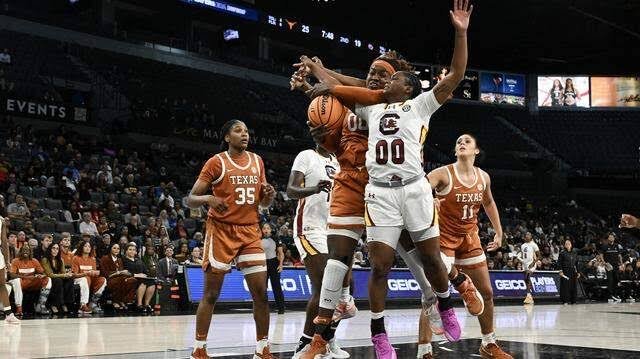
LSU vs South Carolina SEC Tournament semifinal loss analysis begins with the echo of sneakers on hardwood and the tension of a championship crowd in Greenville, where the Tigers’ postseason surge collided with the relentless force of the .
Inside the roaring arena during the semifinals, the fought until the final minute. But once again, South Carolina proved to be the Tigers’ toughest puzzle, pulling away late for an 83–77 victory that ended LSU’s tournament run.
It was the second loss to the Gamecocks this season—and another reminder of the razor-thin margin separating great teams from championship ones.
A Fast Start That Forced LSU to Chase
From the opening possession, South Carolina dictated the tempo.
The Gamecocks attacked the glass aggressively, turned defensive stops into quick transition chances, and forced LSU into a game played at uncomfortable speed. The Tigers—rolling out a smaller lineup featuring young contributors like ZaKiyah Johnson, Jada Richard, and Grace Knox—spent the early minutes absorbing the physicality.
Three-point shots refused to fall.
Spacing tightened. Drives became crowded. Every rebound felt like a wrestling match under the rim.
Meanwhile, South Carolina’s pressure kept LSU scrambling, creating the kind of chaotic rhythm that favors experienced tournament teams.
Yet the Tigers never folded.
Fulwiley Ignites Against Her Former Team
The spark came from junior guard .
Facing her former program, Fulwiley played with an edge that electrified LSU’s bench and brought the Tigers back into the game. By halftime she already had 15 points, attacking gaps in the defense and converting at the free-throw line.
Head coach noticed the difference immediately.
“She’s come alive,” Mulkey said. “She’s playing free. She’s playing with a lot of confidence.”
Fulwiley finished the night with 24 points on 10-for-21 shooting, her most aggressive performance against South Carolina this season.
Every time the Gamecocks tried to create separation, she answered with another drive, a mid-range jumper, or a fearless attack into traffic.
For long stretches, she kept LSU within striking distance almost single-handedly.
Tigers Take the Lead—But Only Briefly
One of LSU’s most telling trends this season has been its ability to close games when leading at halftime.
The Tigers entered the matchup 26-1 when ahead at the break.
And for a moment in the third quarter, it looked like that trend might hold.
LSU grabbed a narrow four-point lead, the crowd buzzing as momentum began shifting toward the purple and gold. The Tigers tightened defensively and finally started generating cleaner offensive looks.
But against South Carolina, leads rarely last long.
Within minutes, the Gamecocks responded with a burst of scoring that flipped the game again. A quick three-pointer, a defensive stop, and a transition bucket erased LSU’s advantage just as quickly as it had appeared.
The game became a tug-of-war.
Possession by possession. Shot by shot.
Three-Point Struggles Prove Costly
As the fourth quarter approached, one issue continued to haunt LSU: outside shooting.
The Tigers simply could not stretch the defense the way they needed to.
Three-Point Shooting Comparison
- South Carolina: 7-for-17 from three
- LSU: 7-for-20 from three
While the raw numbers looked similar, the timing of those shots mattered. South Carolina’s makes often came during momentum swings—daggers that halted LSU runs and restored Gamecock control.
For LSU, several open attempts rimmed out during crucial stretches of the second half.
Those missed opportunities slowly tilted the game.
Against elite opponents, every possession counts—and the Tigers felt that pressure late.
Final Push Falls Just Short
With the clock ticking under two minutes, LSU made one final push.
Fulwiley attacked again. The defense forced a turnover. Suddenly the Tigers were within two points, and the arena buzzed with the possibility of a dramatic comeback.
But South Carolina’s experience showed.
The Gamecocks calmly executed down the stretch—drawing fouls, controlling rebounds, and converting key free throws to seal the win.
When the final buzzer sounded, the scoreboard read 83–77, sending South Carolina to the tournament championship game and ending LSU’s bid for the SEC title.
For Mulkey, the lesson was clear.
“There’s just a small margin of error to beat elite teams,” she said. “We think we’re an elite team—but we’re not there yet in those close games.”
A Frustrating Trend Against South Carolina
The loss continued a difficult streak.
Under Mulkey, LSU is now 0-7 against South Carolina, a statistic that underscores just how dominant the Gamecocks have been in recent seasons.
The Tigers have come close before. Several matchups—including this semifinal—were decided late in the fourth quarter.
But until LSU breaks through, South Carolina remains the benchmark in the SEC.
Fans looking for full tournament brackets and statistics can follow the official coverage on the SEC website:
What This Means for LSU Moving Forward
Despite the semifinal exit, LSU’s season is far from over.
The Tigers still hold a strong national profile and are expected to secure a favorable seed in the upcoming NCAA Women’s Basketball Tournament. With stars like Fulwiley and veteran leader anchoring the roster, LSU remains one of the most dangerous teams heading into March.
Key takeaways from the semifinal loss:
- Improved perimeter shooting will be critical in March
- Handling physical rebounding teams remains a challenge
- Fulwiley’s offensive confidence gives LSU a major scoring weapon
- Late-game execution must sharpen against elite opponents
Those adjustments could determine how far LSU travels in the national tournament.
Because if the Tigers learned anything in Greenville, it’s that they are close—very close—to breaking through.
But “close” doesn’t raise banners.
And that reality defines the story behind this LSU vs South Carolina SEC Tournament semifinal loss analysis.
About the Author